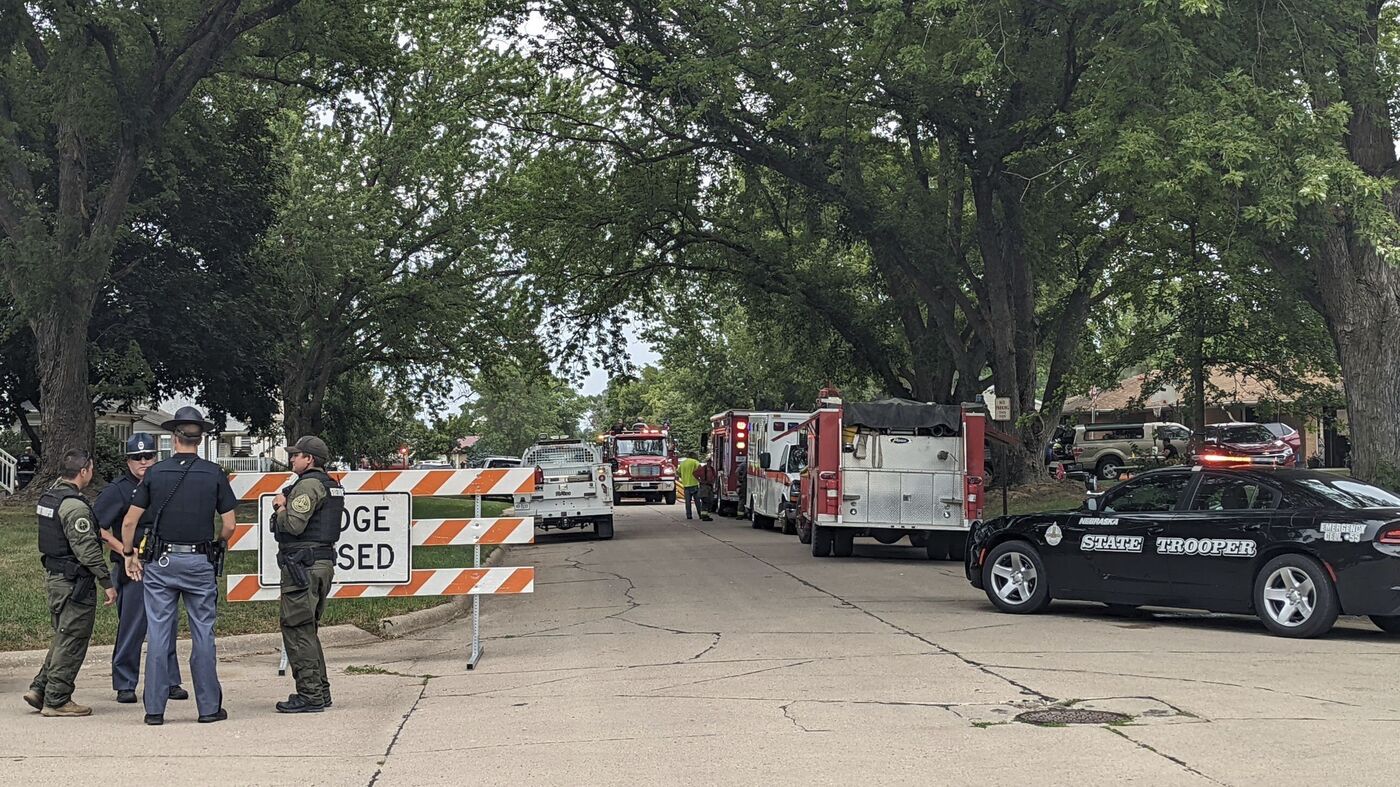
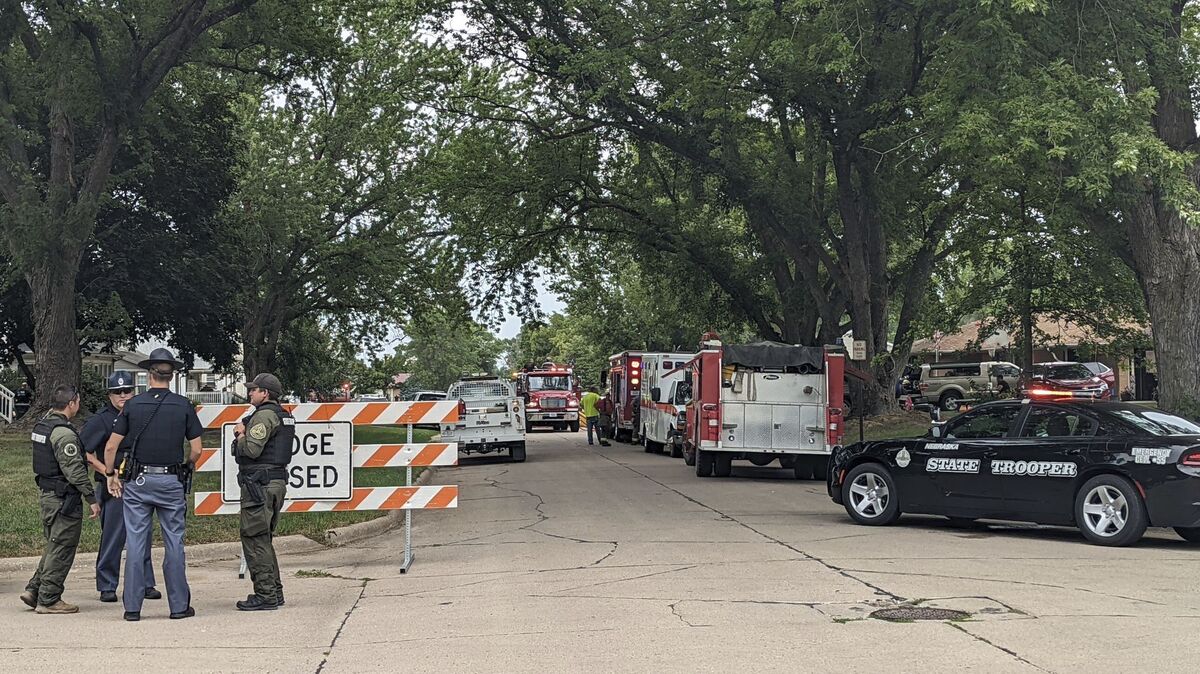
Barricades block off a portion of Elm Street in Laurel, Neb., Thursday, Aug. 4, 2022. The Nebraska State Patrol is investigating a situation with multiple fatalities that occurred in Laurel on Thursday morning.
Riley Tolan-Keig/The Norfolk Daily News via AP
hide caption
toggle caption
Riley Tolan-Keig/The Norfolk Daily News via AP
Barricades block off a portion of Elm Street in Laurel, Neb., Thursday, Aug. 4, 2022. The Nebraska State Patrol is investigating a situation with multiple fatalities that occurred in Laurel on Thursday morning.
Riley Tolan-Keig/The Norfolk Daily News via AP
LAUREL, Neb. — Four people were found dead Thursday in two burning homes in a small community in northeastern Nebraska, authorities said.
Nebraska State Patrol Col. John Bolduc said at a news conference that a man was seen driving away from the city of Laurel before the bodies were discovered and that investigators would like to speak to him.
Firefighters responding to a call Thursday morning about an explosion and fire at one of the homes found the body of a person inside, Bolduc said.
A short time later, firefighters were called to a second burning home a few blocks away, where the bodies of three people were found inside.
Authorities didn’t release the names of the dead or say how they died, but they said witnesses reported seeing a man leaving Laurel in a silver car. Bolduc referred to the man as a suspect in the deaths and said he may have picked up a passenger on the way out of town.
Investigators believe who ever set the fires may have suffered burns, Bolduc added.
He would not say how or whether the victims were related and declined to speculate on the circumstances leading to the killings.
“We’re not categorizing it as anything right now,” Bolduc said.
Laurel is home to fewer than 1,000 people and is located about 100 miles (160 kilometers) northwest of Omaha.
“Laurel is a very safe community,” said Cedar County Sheriff Larry Koranda. “It shakes everybody up.”
Most businesses, a senior center and schools in the community voluntarily went on lockdown around the time the bodies were discovered. That came at the recommendation of the city’s lone police officer, said Lori Hansen, a clerical assistant at the Laurel City Hall. But even community officials were scrambling for information about what was unfolding in the normally quiet town, she said.
“We’ve been listening to TV to try to find out what’s going on,” Hansen said.
In a new update to the Google Search results page, the search engine is now consistently making it clear exactly how words you put in quotes appear on the page.
Many Google searches are handled as a couple of separate words, and the search engine finds relationships between the words to find the best results from across the web. In some cases, Google’s search results would show a snippet chosen by the site, and in others you’ll be shown a relevant preview of the page’s text.
But when you put some of your query into quotation marks, Google makes sure to find those exact words in that precise order. Most of the time, the search results page would also show your quote in its proper context on the page.
Today, Google has announced that its search results page will now always show the quoted words in the context of how they appear. For instance, one previous exception was if the words appeared in the page’s navigation menus or in any other place that wouldn’t make a useful snippet.
In the blog post, the company offers an example of searching for “Google Search” in quotation marks. In the second search result, the phrase “Google Search” appears on the page because it’s used in the alt text of an image on the page. Despite not appearing as standard text on the page, “Google Search” is included in bold in the snippet, along with a nearby sentence to give you an idea of where to look.
Today’s change was apparently made in response to feedback, with Google Search users wanting to always see exactly where on-page the quote appears. In the long run, it’s a fairly minor tweak, but it could make things easier for some, or at least make it more obvious why a particular page is appearing as a result.
More on Google Search:
FTC: We use income earning auto affiliate links. More.
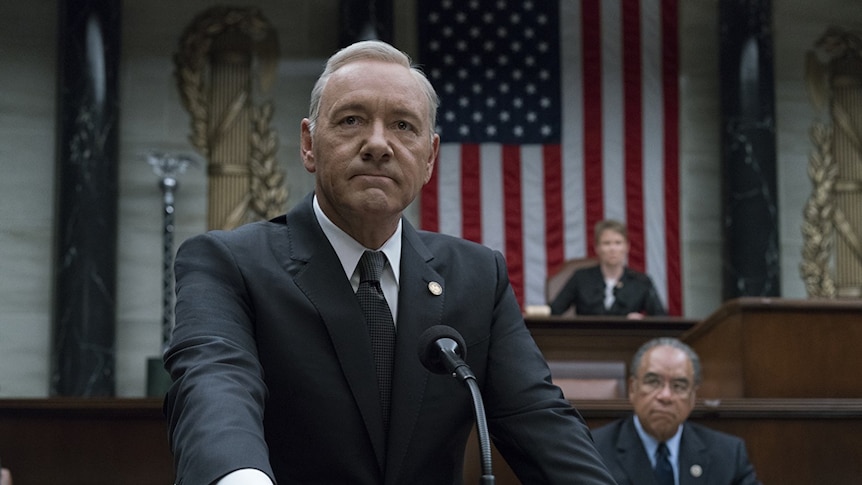
A judge has ruled Kevin Spacey and his production companies must pay the producers of hit TV show House of Cards nearly $US31 million because of losses brought on by his 2017 firing for the sexual harassment of crew members.
Key points:
A private arbitrator awarded $US30.9 million to companies that produced House of Cards last year
A Superior Court judge has now approved the ruling, writing that Spacey’s attorneys failed to show the payout was “irrational”
The arbitrator found Spacey had violated his contract through engaging in unprofessional behavior with crew
The ruling gives the force of law to a private arbitrator’s decision to award $US30.9 million ($44.3 million) in favor of production company MRC and others.
Los Angeles Superior Court Judge Mel Red Recana wrote that Spacey and his attorneys “fail to demonstrate that this is even a close case” and “do not demonstrate that the damages award was so utterly irrational that it amounts to an arbitrary remaking of the parties’ contracts.”
“We are pleased with the court’s ruling,” MRC attorney Michael Kump said in an email to The Associated Press.
Spacey has denied the allegations through his attorneys and his spokesperson, who did not immediately respond to emails seeking comment.
The arbitrator found that Spacey violated his contract’s demands for professional behavior by “engaging certain conduct in connection with several crew members in each of the five seasons that he starred in and executive produced House of Cards,” according to a filing from Mr Kump.
As a result, MRC had to fire Spacey, halted production of the show’s sixth season, rewrite it to remove Spacey’s central character, and shorten it from 13 to eight episodes to meet deadlines, resulting in tens of millions of dollars in losses, according to court documents.
Spacey’s attorneys argued in their own filings that the decision to exclude him from the show’s sixth season came before the internal investigation that led the crew members to come forward, and thus was not part of a contract breach.
They argued that the actor’s actions were not a substantial factor in the show’s losses.
The ruling from the private arbitrator came after a legal fight of more than three years and an eight-day evidentiary hearing that was kept secret from the public, along with the rest of the dispute, until a panel of three more private arbitrators rejected Spacey’s appeal. and upheld the decision from November.
The 63-year-old Oscar winner’s career came to an abrupt halt late in 2017 as the #MeToo movement gained momentum and allegations against him emerged from several places.
Spacey was fired or removed from a number of projects, most notably House of Cards, the Netflix political thriller where for five seasons he played lead character Frank Underwood, a power-hungry congressman who becomes US president.
Last month in London, Spacey pleaded not guilty to charges of sexually assaulting three men a decade or more ago, when he was director of the Old Vic theater there.
His lawyer said he “strenuously denies” the allegations and he is set to face trial next year.
Another criminal case brought against him, an indecent assault and battery charge stemming from the alleged groping of an 18-year-old man at a US resort, was dismissed by Massachusetts prosecutors in 2019.
Spacey also faces lawsuits from other men, including actor Anthony Rapp.
Space to play or pause, M to mute, left and right arrows to seek, up and down arrows for volume.
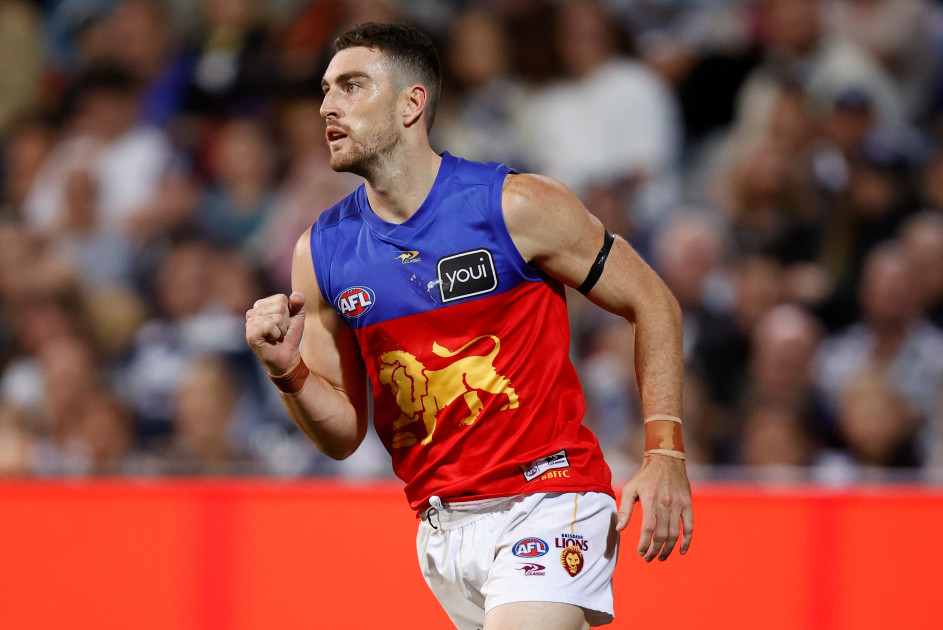
Collingwood appears the likely destination for Daniel McStay should he depart Brisbane at year’s end.
The Magpies have reportedly offered the Lions free agent a five-year deal worth close to $600,000 a season.
McStay has kicked 16 goals in as many appearances this season and hasn’t troubled the scorers in five of his last six games.
The reported figure Collingwood is prepared to offer McStay has raised some eyebrows within AFL circles.
Dermott Brereton has floated two fringe Swans players the Magpies could look at instead of the Lions forward.
Subscribe to the SEN YouTube channel for the latest videos!
“I would query why you would put so many dollars in a player into your list,” Brereton told SEN’s The Run Home.
“They’ve probably got the answers.
“He will stand under the ball. He’s brave as they can be, Dan McStay, he will take punishment.
“I just mentioned his name, Hayden McLean and Joel Amartey, one of those two boys, who have come to be very capable, if they all stay fit in Sydney, they won’t play a game.
“I would look at getting one of those.
“It’ll be one-third of the price of a Dan McStay and you might be able to cultivate and groom him into what you want.”
McLean, who is contracted for 2023, has played eight games in 2022, kicking six goals.
The 23-year-old has made 30 appearances since debuting in 2019.
Amartey is also contracted for next season. The 22-year-old has played six games this year.
Trapped in a never-ending cycle of back pain and locked in a compensation battle with a government department that had placed her under surveillance, Jacqui Lambie lost hope completely.
She wrote her sons a farewell letter each and tried to take her own life.
Key points:
Senator Lambie joined the Army as an 18-year-old and was eventually medically discharged after a back injury
The discharge began a six-year battle with the Department of Veterans’ Affairs for compensation
Senator Lambie has been a vocal critic of the department during her political career and a key campaigner for the establishment of the royal commission
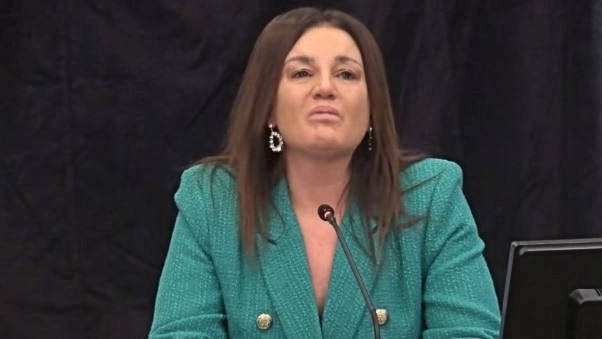
“There was no point. There was nothing left of me after that. I had no fight left in me,” the independent senator told a Hobart hearing of the Royal Commission into Defense and Veteran Suicide.
But instead of ending her life, she said the suicide attempt played a role in restarting it, with the Department of Veterans’ Affairs finally giving her the intense psychological care she needed.
It began a slow journey of rehabilitation, and a desire to do what she could to make the lives of veterans better, that eventually led to her being elected to Federal Parliament in 2014.
“I made a deal with God: if you’d just give me a second chance at life, I’d fight like hell for the veterans because I could understand what was going on and they weren’t getting a fair deal,” she said.
“From where I was to where I am today I’m very grateful that God has given me a second chance at life and that I have somehow been able to swing that around.”
Army ‘a life-saver’
Senator Lambie joined the Army as an 18-year-old in 1989.
Frequently in trouble, her family was supportive of her enlistment.
Jacqui Lambie was 18 when she joined the Army.(Facebook: Jacqui Lambie)
“I was seen to be around a bad group of people at that point of time who were bad influences, so for me, it was probably a life-saver that I had the opportunity to serve my country,” she said.
She told the commission she initially thrived in the environment, but it was not long before she was thrown into a curveball.
Without the knowledge of her or her superiors, she was pregnant, with the Army pushing to end her military career before it even really began.
“What they wanted me to do was discharge immediately and get going, but I did not want to discharge because I didn’t want to end up back in public housing with a child,” she said.
With the help of a lawyer, the Army relented, and Senator Lambie completed her basic training.
Her career almost ended again eight years later when she was charged following an incident.
“Quite frankly, after I got charged for basically assault, I should have been thrown out of the military and they did not do that for me,” she said.
“They gave me a second chance and I will always be very, very grateful for having that second chance.”
Space to play or pause, M to mute, left and right arrows to seek, up and down arrows for volume.
Jacqui Lambie in tears while thanking her sons, who ‘paid a heavy price’ while she deteriorated.
‘I just couldn’t take it anymore’
She was sent on a compassionate posting to Devonport, in Tasmania’s north-west.
It was while she was based there, but on an infantry training course in Puckapunyal, that she suffered the first of what was to become a debilitating back injury.
“When I went to get out of bed, I could not get out of bed, I could not move,” she said.
Jacqui Lambie (left) pictured during her military service.(Facebook: Jacqui Lambie)
It started a two-year cycle of physiotherapy, painkillers and hiding her pain.
Two days before she was set to fly out to East Timor on deployment, her back gave in.
“For me that was it, I just couldn’t take it anymore,” she said.
“I just ended up flat on the floor and then that was pretty much the end for me once that happened.”
She was medically downgraded and sent to specialists for a solution, but her back would not recover.
Eventually, she was medically discharged in 2000.
Senator Jacqui Lambie hoped the commission would lead to lasting change for veterans.(Supplied: Royal Commission into Defense and Veteran Suicide)
The discharge began a six-year battle with the Department of Veterans’ Affairs for compensation, as well as debilitating pain and depression.
“The pain itself was completely out of control and it set into a pattern that once that set in, I had just about given up,” she said.
She told the commission that the Department of Veterans’ Affairs initially deemed her not unfit enough to receive an allowance on top of her disability pension.
Government surveillance from bush behind her house
She engaged a lawyer after being defeated by the process and initially had a series of small victories before a visit to a shopping center changed her life.
Senator Lambie was spotted carrying two shopping bags walking out of a two-dollar shop.
She told the commission the Department of Veterans’ Affairs and Commonwealth Rehabilitation Services decided to put her under surveillance after suspicions she was faking her injuries.
Representatives from the rehabilitation service filmed from a bush near her back fence “with a camera lens coming over that fence”, watching her friends and children, she said.
They captured footage of Senator Lambie over several weeks, taking footage of her getting changed, and also interviewed people who knew her.
“There was an occasion where we were getting changed [inside her home] and I had my girlfriends there, we must have been trying on tops — they did film that,” she said.
“I found that terribly intrusive and quite frankly there was no reason to do that video surveillance.”
That resentment over the surveillance led to Senator Lambie failing to show up to a series of meetings with Commonwealth Rehabilitation Services and the Department of Veterans’ Affairs, and the cancellation of her benefits.
The fight for compensation eventually ended in 2006 after the department accepted Senator Lambie was entitled to compensation.
She accessed medical treatment and her back injury slowly improved, allowing her to work in the office of Tasmanian Labor Senator Nick Sherry.
Senator Lambie urged veterans to come forward and share their story.(ABC News: Luke Bowden )
Life ‘spiraled out of control’
But she told the commission a setback proved devastating.
“Life completely and utterly spiraled out of control because I went back to pre-days where there was just so much pain and by then I’d lost all hope,” she said.
Senator Lambie said her mental health deteriorated to the point where she tried to take her own life.
“I found it difficult to be able to give a reason… to have reason to continue to live, even for the sake of my sons because I believed I was doing them more damage than good,” she said.
Senator Lambie finally received the psychological help she needed and started to rebuild her life, but said her “10 years of hell” took a huge toll on her family, especially her youngest son.
“He has really struggled during his life and… the reason that is because of what he had to go through with me,” she said.
Senator Lambie has been a vocal critic of the Department of Veterans’ Affairs during her political career, and a key campaigner for the establishment of the royal commission.
She paid tribute to the “peacemakers and peacekeepers” who helped make the commission happen, and hoped it would lead to lasting change for veterans.
“If you do not come forward now and tell your stories, even if you do not want to do it for yourselves, do it for your mates because there is nothing else if we do not fix it this time,” she said.
“I’m asking you to find the courage, whether you are serving, or whether you are not, you need to come forward because this is it.”
NASHVILLE, Tenn. (WKRN) – Find up-to-the-minute election results from the August 4 Tennessee primary election and the Middle TN county general elections.
You can find all the election results from August 4 here. You can also find links to specific statewide and county races below.
Key Tennessee Races to Watch
5th US Congressional District: Election Results
The fifth Congressional district for Tennessee is up for grabs following the retirement of longtime Democratic incumbent, Rep. Jim Cooper.
Nine Republicans are vying for the GOP nomination in the race for Nashville’s 5th District now includes only the southern portion of Davidson County, parts of Wilson and Williamson counties, and all of Lewis, Maury, and Marshall counties.
Heidi Campbell, a member of the Tennessee state senate, is running unopposed in the Democratic primary.
While Governor Bill Lee is unopposed in the Republican primary, three Democrats are hoping to be the one to take him on in the general election in November.
All Statewide Races
Tennessee Republican Primary: Election Results
Tennessee Democratic Primary: Election Results
General Election Results by County
Cheatham County Elections
Davidson County Elections
Dickson County Elections
Montgomery County Elections
Robertson County Elections
Rutherford County Elections
Sumner County Elections
Williamson County Elections
Wilson County Elections
📲 Download the News 2 app to stay updated on the go. 📧 Sign up for WKRN email alerts to have breaking news sent to your inbox. 💻 Find today’s top stories on WKRN.com for Nashville, TN and all of Middle Tennessee.
This is a developing story. WKRN News 2 will continue to update this article as new information becomes available.
The funds’ management arm, which raises money for external fund managers via Ironbark-branded vehicles, is the biggest arm representing strategies like global long/short from New York-based Apis Capital and listed infrastructure at local fundie Maple-Brown Abbott.
The trustee business provides responsible entity services for funds and financial advice business, while the wealth advisory arm has been taking minority stakes in advice businesses.
Soul Patts’ capital was understood to be earmarked for use for organic growth spending, as well as acquisitions of stakes in advice businesses. Sources said Ironbark received interest from family offices, but deep-pocketed Soul Patts ended up taking the entire raising.
It follows a small re-up from Soul Patts’ 29.1 per ownership in early 2021, to 30.7 per cent a year later, with Soul Patts paying $2.82 million for the 0.2 per cent increase at the time.
Ironbark is a smaller funds management play from Soul Patts. It owns a 36.5 per cent stake in Pengana Capital Group, and last year capped off a $10.8 billion merger between itself and listed investment company Milton Corporation.
Soul Patts’ investment was overseen in-house, while Ironbark was understood to have been advised by Nelson Lam of Berkshire Global Advisors.
Google has updated how search result snippet in Google Search for queries that contain quotes. Now, Google will show where that exact phrase appears on the page in the search result snippet in Google search, the company announced.
What this means. Google explained if you did a search such as [“google search”]the snippet will show where that exact phrase appears:
Previously. Google said previously, Google Search did not always show the quoted search phrase in the Google Search result snippet “because sometimes the quoted material appears in areas of a document that don’t lend themselves to creating helpful snippets,” Google said. “For example, a word or phrase might appear in the menu item of a page, where you’d navigate to different sections of the site. Creating a snippet around sections like that might not produce an easily readable description,” Google added.
Why the change? Google said they made this change based on searcher feedback, Google wrote “We’ve heard feedback that people doing quoted searches value seeing where the quoted material occurs on a page, rather than an overall description of the page. Our improvement is designed to help address this.”
More advice. Google then gave searchers additional advice on how quotes work in Google Search and how this may impact your search results. Check out their blog post over here.
Why we care. Google confirmed with Search Engine Land that this is not a ranking change but rather a user interface change on how Google Search will show some searches, searches that use quotes. This may impact your click-through rate from the Google search results but will have no impact on how you rank for those types of queries.
New on Search Engine Land
About The Author
Barry Schwartz a Contributing Editor to Search Engine Land and a member of the programming team for SMX events. He owns RustyBrick, a NY based web consulting firm. He also runs Search Engine Roundtable, a popular search blog on very advanced SEM topics. Barry can be followed on Twitter here.
There’s a generational cycle in cinema which is fairly invariable: Quentin Tarantino has famously spent his career riffing on the exploitation movies of his 1970s youth, and now Bullet Train Screenwriter Zak Olkewicz is riffing on Tarantino and Guy Ritchie, presumably equally formative experiences for a kid born in 1983.
There is nothing in Bullet Train to invest in emotionally, nor did I find it especially funny or thrilling.
It makes for a very talky journey, far from the non-stop thrill ride promised in the title, and only slightly briefer than the actual bullet train ride between the cities in question (you can make the trip in two hours and 15 minutes, according to toGoogle).
Moreover, most of the action has to unfold without the driver or the civilian passengers getting too suspicious, and thus has to happen in short, sharp, close-up bursts, rather than the flowing cadenzas of John Wick (which Leitch co-directed – still his career high point).
That Thomas the Tank Engine thing, by the way: it isn’t a one-off gag, it’s the primary, defining trait of Henry’s character, as if Samuel L. Jackson spent all his screen time in pulp fiction talking about the pig from Green Acres.
Quirks of this variety are meant to contrast with the cartoonish ruthlessness all the characters share, to the point where the decent sorts are the ones who aren’t literally pushing children off rooftops (a misdeed performed by a demure schoolgirl villainess, played by The Kissing Booth star Joey King in a baby-pink coat).
The trouble is that actual Japanese filmmakers are in a different league with this sort of stuff: Leitch is in no position to crank up the perversity and nihilism to match, say, Sion Sono, though he may well have seen a few Sono films in his time.
loading
There is nothing in Bullet Train to invest in emotionally, nor did I find it especially funny or thrilling. But I’m prepared to give Leitch and company a few points for trying something offbeat enough that by current Hollywood standards it practically qualifies as art for art’s sake.
It must have been Pitt’s enthusiasm that got it financed; Perhaps it reminded him of his 1990s glory days, when he must have spent a fair amount of time between projects leafing through screenplays about goofy hitmen.
It says much for the unchanging rhythms of football that, despite being 26 years apart, the two most famous pre-season camps in Adelaide Crows history each took place in the closing days of January.
In 1992 in Rapid Bay, the club was about to enter its second AFL season and searching for that something extra to go from a respectable 10 wins and mid-table to a finals berth. Reading an in-flight magazine some months earlier, All-Australian defender Nigel Smart thought he had found it.
Essendon Football Club draft players blindfolded during a camp in the Cann River region in 2003.Credit:Joe Armao
A motivational speaker and expert in firewalking, Paul Blackburn, would work the Crows into such a frenzy of self-belief that they could walk over hot coals for one another. It did not quite work out that way.
“People laugh at that but he actually walked across those hot coals,” the inaugural coach Graham Cornes has said. “He had a few blisters, that’s why we called it off because he looked uncomfortable.
“You’ve got no idea how hot those coals were. It was created from a big truckload of Mallee roots, a glowing, throbbing, pulsating, radiating mass of heat. By the time they scraped out a 10m by 1m area to walk on, the enthusiasm had waned a little bit.
“We laugh about it now, but it was a public relations disaster for the club.”
Why do sporting and corporate organizations run bonding camps?
One of the better explanations was delivered by Andy Flower, then England’s head coach, before he took the 2010-11 Ashes squad to Germany for a five-day slog in which the team led by Andrew Strauss was harried around the Bavarian forest by Australian police officers teed up through the team’s head of security Reg Dickason.
England fast bowler James Anderson suffered rib injuries in a sparring match at a pre-Ashes training camp in Germany.Credit:Getty Images
“It is designed to educate all of us, to give us a good sense of perspective on things, to allow the guys to become more self-aware, and allow the guys to understand each other better,” Flower said. “We can live in a cosseted world, in the sporting world, and this is there to broaden minds. It’s not related to the Ashes at all, it’s more about our development as a group of blokes.”
That trip did generate headlines, as the lithe England spearhead Jimmy Anderson suffered a fractured rib in a sparring match with his far burlier fellow opening bowler Chris Tremlett. On their subsequent triumph in Australia, however, players and staff did not recall the physical pummeling so much as relationships built at nightly campfires, away from mobile phones and other noise.
It may not have improved Anderson’s outswinger, but it helped engender a sense of unity when the cricket started – a similar recollection was shared this week by the former Australian wicketkeeper Adam Gilchrist about a similar exercise before the 2006-07 Ashes. Even vocal dissenters to that exercise, such as the late Shane Warne, were on board with it by the finish.
Neil Balme, a coach, mentor and football manager at Norwood, Melbourne, Collingwood, Geelong and Richmond, went on his first pre-season camp as a player with the Tigers in the summer of 1969-70. He recalls being told, by way of an incentive, “if you sign up with us you get to go on the camp!” They’ve been a part of the team-building kitbag ever since.
“You put them together so the players can figure each other out, and you as the coaches and administrators help that to happen,” he says. “Usually it’s to collaborate, to learn how the next bloke works, how you can help him and how he can help you. Those are the things that will make a difference during the season ultimately.”
After having their genesis with a football club’s own staff, facilitators of such camps have been drawn from far and wide. Psychologists, law enforcement or military types, outdoor experts. They have evolved in a few senses over the years.
Brisbane Lions players push a truck out of sand on their pre-season camp in 2014.
“All of us in elite team sport have been involved in a million camps – the motivation behind it is an admirable one,” former Collingwood and Brisbane Lions coach Leigh Matthews told Adelaide radio this week. “Way back in 1987, Collingwood, we’d finished second last and I was coach. We decided to have a tough experience together outside your general footy thing. It was in the Gippsland rainforest, and a couple of training guys from the SAS were running the camp.
“They were to be out there for three days, they carried everything they had. Very little communication with the outside world. And they got lost. We only knew this in retrospect, but because they had a genuine life-threatening experience, that ended up being a really bonding, positive influence on that group. You can never plan it to be that bad – it only went that bad because they got lost. But clubs do a lot of things trying to find that competitive advantage, and they can go wrong.”
Initially, physical strength and endurance training was the best part of the brief, particularly in the semi-professional era when a whole week with a group of players was seen as a luxury, away from day jobs and time constraints. They were also useful exercises for bringing along a camera crew to help promote how hard the club was working to bring success to its members that year.
“Back in the day it was a chance to make them run up a hill and all those sorts of things and have a day to recover rather than having to go to work the next day,” Balme says.
But as football and sport have become more thorough in physically preparing players year-round, increasing emphasis has been placed on the mental challenges presented. Overcome these obstacles, the brief often indicates, and opponents during the season will seem altogether more straightforward as a result.
Terry Wheeler, a forerunner in a few ways as a senior coach, aimed for that kind of gambit when he had Footscray players parachute into Port Phillip Bay ahead of the 1993 season. Secrecy, too, has often been a part of it – players whisked away to an undisclosed location, disoriented and challenged. Although as Balme reflects, secrecy in football generally relates to something else.
“Usually, secrecy is about doing something you shouldn’t be doing!” I laugh. “The secrecy is not necessary. We should be able to show everyone what we do and say ‘this is the way to do it’ and away you go.
“Sometimes secrecy in how you play is there, you don’t want to tell everyone how you play, but it’s pretty obvious how you do, they’ve only got to watch you. Quite often secrecy will be about covering up something they don’t want people to know because it’s not right, rather than because it is right.”
In Melbourne, the Storm’s “I Don’t Quit” camps – run by past and present members of the Special Operations Group – built up such a reputation that they were co-opted by the Demons ahead of the 2017 season. That first, two-day camp covered familiar territory in terms of physically and mentally challenging players.
But when Dom Tyson hurt his knee and Christian Salem accidentally dropped a brick on his head, causing a concussion, players harbored enough concern to take the concept to the AFL Players’ Association when coach Simon Goodwin planned to undertake the same experience again ahead of 2018 Melbourne’s players, having fought for greater self-determination, would go on to a premiership.
That, of course, was the same summer in which the Crows undertook their own fateful camp in Queensland, after players had initially thought they were headed to the Gold Coast for swimming, some light training and time together to talk through the lost 2017 grand final .
What is now clear is that the camp designed for Adelaide was meant to go harder, reach further, and challenge more deeply than any pre-season camp had ever done before. It was going to push the envelope of resilience for a team that, only two years before, had forged through the unspeakable trauma of having their former head coach Phil Walsh murdered in mid-season.
Adelaide Crows players in the “power stance” as they line up for the 2017 grand final against Richmond.Credit:Getty
“Ego control can be part of the problem,” Balme says. “It should be about ‘what do the players need’, not making it bigger and better than last year. The camp won’t define your year for you, it’s how you play. There was a bit of ra-ra and ego sometimes about planning these things, but you’ve got to get past that, and if you do, you’ll make better decisions.”
Ironically, the evolution of men and athletes over the past 30 years has afforded greater openness and chances for connection without having to resort to the blunt instrument tactics that had previously been used to break down the egos and closed minds of their predecessors.
Samantha Graham, a mind coach who was instrumental to the success of the South Sydney Rabbitohs in 2014, has argued there is actually no need to push athletes to breaking point to find the vulnerability that brings honest conversations, connection between people, and ultimately better performance .
“That’s plenty of vulnerability right there for most groups of men, in my experience,” Graham told good weekend in 2018. “Take them out of their comfort zone, because that’s where learning happens. But you don’t want to take them into their terror zone, because it’s not productive or ethical.”
loading
As for the Crows, Josh Jenkins pointed out in 2019 that the perspective behind the camp’s efforts to stretch the team was at a distance from the reality of a season in which the club had done everything but won the grand finale.
“I think when you lose a final and even more so a grand final — and prelim finals as well — I think you need to remember that you’re one of the teams that need to improve the least, not the most,” Jenkins told SEN radio.
“We sort of went down a path of needing to change everything and we needed to rebuild ourselves as individuals and a team. That was clearly a mistake. That’s probably the main area we fell away.”
Says Balme of the mental side of the game: “It’s all ongoing, it’s day-to-day stuff. You can’t take a team away for a few days for an experience that changes everything, which is sometimes something I think we tried to do at those camps. Now it’s much more about the reality of how we prepare to play as well as we can for as long as we can.”
As Cornes rightly pointed out, the blisters suffered by Nigel Smart may not have looked good on television, but they were minor enough to allow him to play in the Crows’ next pre-season game five days later.
What’s less widely known about the whole episode is who called it off. Not Cornes, nor Smart, but the inaugural chairman of the Adelaide Football Club himself, Bob Hammond, who happened to be on-site. As a former player, coach and administrator of distinction, Hammond had a well-developed bullshit detector.
loading
Senior oversight of events such as pre-season camps does in some ways appear to have been simpler in the days when clubs could number their staff by the tens, not the hundreds.
But in 2018, none of the chairman Rob Chapman, the chief executive Andrew Fagan, nor the football director Mark Ricciuto were present. The most senior men on the ground were the head coach, Don Pyke, and the head of football, Brett Burton. It’s not clear which camp exercises they participated in or witnessed.
In the four years since then, every club pre-season camp program has required sign-off by the AFL itself before going ahead, to ensure the mental and physical health of all involved. In any case, commando-style camps are out of vogue.
The camp was at the time rationalized as necessary to find the competitive edge that would take the team to the top. The Crows have been walking on metaphorical hot coals ever since.
Keep up to date with the best AFL coverage in the country. Sign up for the Real Footy newsletter.